Nikole Hannah-Jones wrote an 8,300-word essay for The New York Times Magazine last weekend, a follow-up to her 2016 essay, about her decision to enroll her daughter, Najya, in a high-poverty, majority-Black New York City public school. The moment I saw the headline, “In Fighting for Every Black Child, Did I Betray My Own?” I knew what was coming.
The commiseration from people who had been through the same thing. The backlash. The smug comments from people who want to see Hannah-Jones struggle, personally. The people who devalue her work as an advocate for racial equity and truth-telling in America.
And chatter about the story itself, of course.
About how Hannah-Jones’ desire to affect positive change for New York City’s segregated school system drew the ire of her daughter, who felt she didn’t have the educational experience she wanted in an under-resourced environment. About how, as Najya navigates a new high school she got to choose — one in a more affluent, predominantly white neighborhood — and will soon apply to colleges, she feels regret about putting her drive to change an unjust system above her daughter’s individual education.
“This girl, my only child, looked to me to protect her, to give her what she needed to thrive. And I had not chosen her,” Hannah-Jones wrote.
Very little about Hannah-Jones’ essay surprised me, as a Black kid who became a Black adult who has worked with Black kids in predominantly Black neighborhoods and now has a Black daughter in elementary school.
But I wasn’t quite prepared, despite all the time I’ve spent turning this exact topic over and over in my mind, for how I would feel about it when I finished reading the piece.
I started it while sitting in my car. I kept reading as I opened the screen door to my house. Then I stopped where I stood, unable to leave the foyer, as Hannah-Jones, the author of “The 1619 Project” and one of the most well-known critics of our nation’s education system, got personal.
And as I stood there, reading and unmoving, I felt the echoes of my parents’ own choices for my education. They made sure I went to school in Hobart, Indiana — a whiter, more middle-class town — rather than enroll in poorer school systems, in Gary or Merrillville. They moved me from public to private school as a fourth-grader (against my protests) to offer me a greater intellectual challenge.
I got what I needed from my primary and secondary education. I went to the University of Chicago, one of the best universities in the world, and got a master’s degree from the University of Notre Dame — achievements my parents and most of my family couldn’t have dreamed of.
Kids tried to wedge quarters into my hair on the bus and told me to smile when I walked into a dark room, so people could find me.
But, as one of the few Black children in those spaces — sometimes the only one — the emotional cost was high.
Kids tried to wedge quarters into my hair on the bus and told me to smile when I walked into a dark room, so people could find me. Guidance counselors discouraged me from applying to top colleges — despite my being among the top-10 students in my class — because they didn’t think it would be a good “fit.” Then, when I earned admission to said schools, people quipped that the only reason I got in was that I was Black, not because I’d earned it.
I hated it, and part of me has never forgiven my parents for putting me on that path.
By some strange fortune, and because preschool options were hard to find, we enrolled my daughter, Maya, in The Croft School, an independent school in Jamaica Plain for pre-school and kindergarten (though I had been mulling a switch to Boston Public Schools). When the Croft closed — after a massive financial scandal — I found myself facing the opposite choice my parents made: to abandon private schooling and put Maya in BPS.
Would my daughter, who at 6 years old was already a voracious reader and showing interest in multiplication and division, be challenged enough in public school? I struggled with boredom in school as a kid, even though I didn’t want to leave my public school behind.
Was saving a few thousand dollars every month worth the potential cost to her future?
Was the allure of private schools — which proliferated in the 1950s and '60s in the U.S. as white families sought an escape from school integration — just a ruse to make us look down on public institutions and their majority-minority students, thereby perpetuating their defunding and disinvestment?
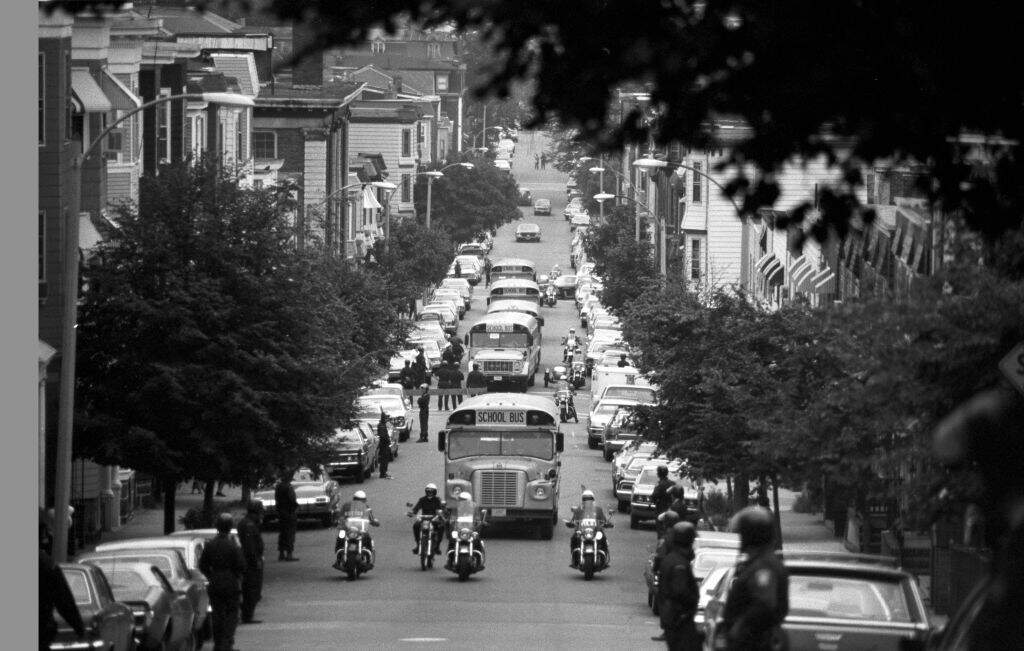
Accompanied by motorcycle-mounted police, school buses carrying Black students arrive at formerly all-white South Boston High School on Sept. 12, 1974, the first day of federal court-ordered busing to achieve racial balance in the city's de facto segregated schools. (Spencer Grant/Getty Images)
Right now, Maya is a first-grader at Sarah Roberts Elementary, a Boston public school, and a diverse, inclusive setting where she is thriving. I hope she stays there all the way through sixth grade. We couldn’t be happier.
But that might not always be the case. What if we have to make a change one day, or risk exactly the reckoning Hannah-Jones is going through right now?
One thing feels certain to me as I continue to process what I read, what I went through, and what public education — under duress due to funding cuts from a hostile presidential administration — is facing. The simple act of being Black and seeking an education in this country has been an intensely political act since our nation’s inception, and no number of Civil Rights Acts and desegregation protests have changed that fact, because animus toward Black people is part of America’s DNA.
Public or private. Suburban or inner city. Rich or poor. Educated or not. Together or apart. Two-hundred and fifty years of American history, and an even longer history before that, show us these distinctions don’t matter.
Whether we want to admit it or not, the perception of a failing public school system in America is most often pinned to a Black face. The schools with the highest dropout rates, highest expulsion rates, and the lowest rates of college matriculation, as the UCLA Civil Rights Project report Hannah-Jones cites in her piece shows, are also intensely segregated: about 85% of black students and 75% of Latino students in New York City attend intensely segregated schools, as compared to only 11% of white and 43% of Asian students. Black and Latino students in NYC disproportionately attend schools where more than 75% of households are below the poverty line, far more than white (22%) or Asian (42%) students. That’s not just an issue in New York, which the UCLA report once labeled “the most segregated state in the U.S. for black students.” Mind you, this is 72 years after Brown v. Board of Education struck down legalized school segregation.
Here in Massachusetts, a 2024 state advisory council investigation found that 63% of all schools are segregated or intensely segregated, and that schools with higher concentrations of students of color saw worse outcomes on metrics like graduation and college matriculation.
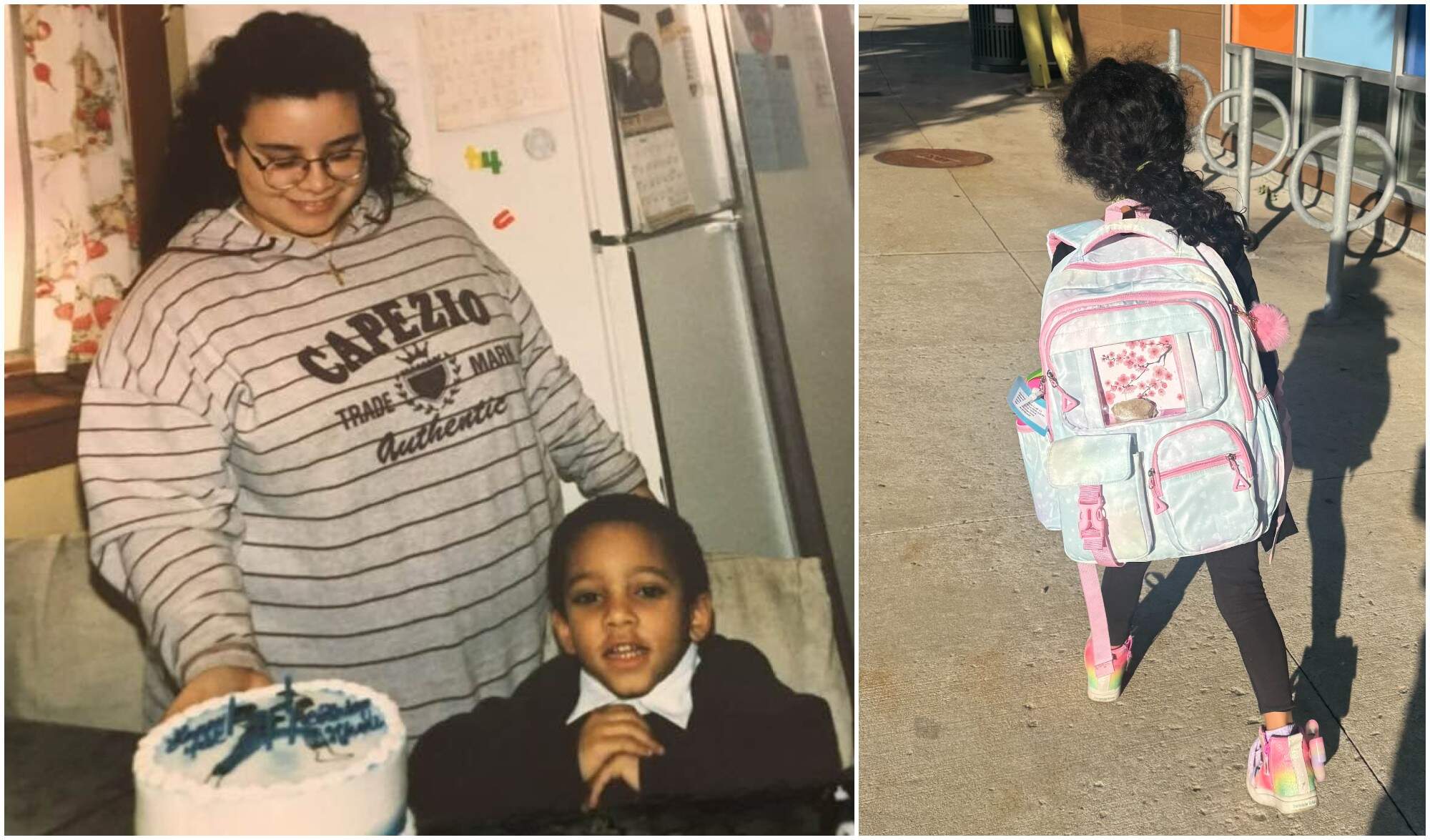
The author, in his school uniform, as a child. The author's daughter, Maya, on the way to school in Sept. 2026. (Courtesy Khari Thompson)
These stark numbers lead many families, including more affluent Black families, to believe they must abandon predominantly Black and Brown public school systems for private schools, if they’re to provide the best opportunities for their children.
But doing so often isolates Black children in predominantly white spaces, forcing them to navigate racism — both overt and covert — as the price of their improved educational outcomes. Hannah-Jones essay makes that argument. I’ve lived it myself.
Still, the takeaway from Hannah-Jones’ piece is not simply about a personal choice, or whether or not public education is inherently doomed. It’s the fact that Black parents must accept that there are no perfect outcomes for their children in a system designed to hurt them no matter where they go.
If we want to live in a world where everyone has truly equal opportunities for a quality education, the decision about where we choose to send our children can’t be a neutral one. “As long as we continue to rescue our own children from the failing schools where we allow other people’s children to languish simply because those children have been born Black and poor in a nation of racism and riches, there is no absolution here,” Hannah-Jones concluded.
She invokes the history of people like Leona Tate, whom she interviewed for her essay, and Ruby Bridges — two young Black girls whose parents chose to send them to all-white schools as part of the post Brown v. Board integration efforts. And every day, when school begins, my daughter proudly recites a school pledge in honor of Sarah Roberts, “brave and strong”— a girl whose name was attached to a landmark lawsuit against segregation in Boston schools when she was Maya’s age, in the mid-1800s.
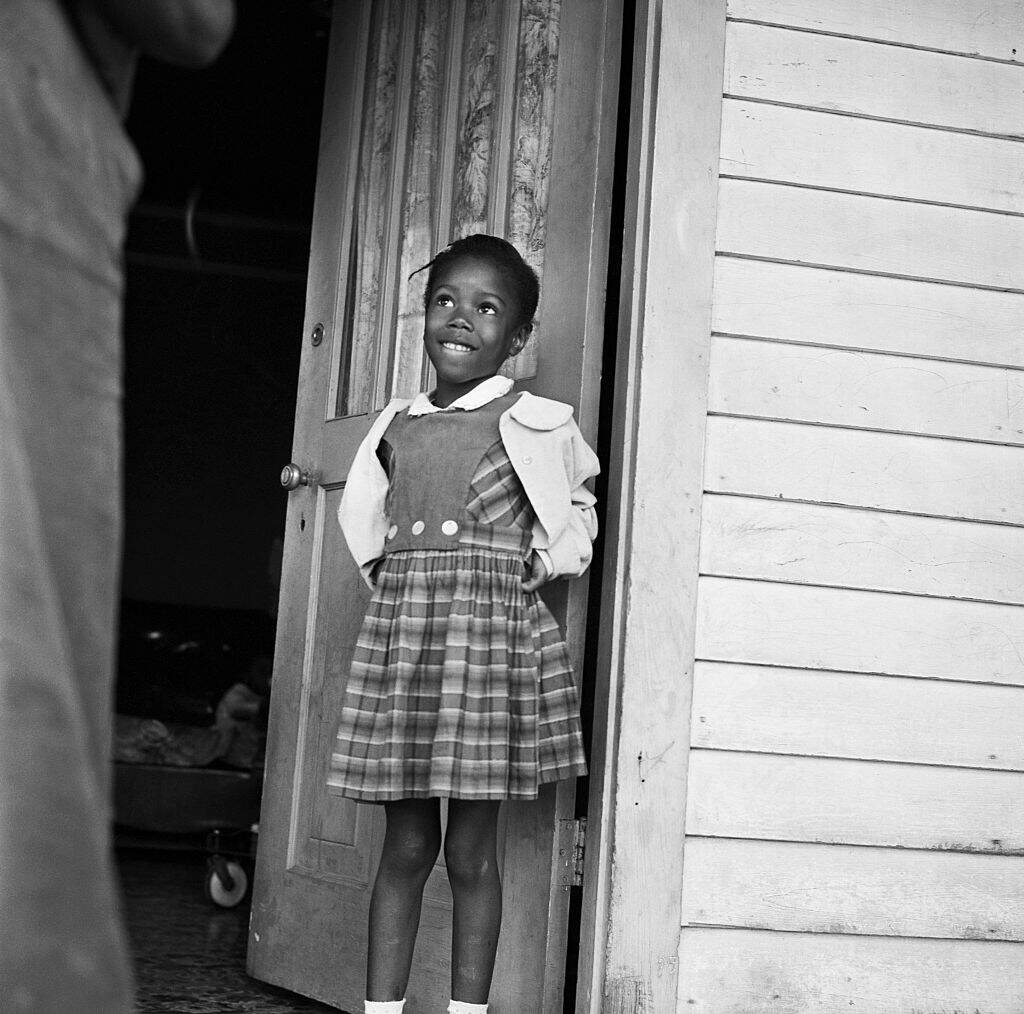
Ruby Nell Bridges at age 6, was the first Black child to attend William Franz Elementary School in New Orleans after Federal courts ordered the desegregation of public schools. (Getty Images)
We celebrate their stories now. But we wouldn’t have had that chance had not their parents put them forward as agents of the desegregation effort. That was, as we’d say today, a “political choice.”
So is my choice to speak plainly to Maya about racism and what it means to be Black.
She reads the same copy of “The Story of Ruby Bridges” I used to go to sleep with each night, back when I was the only Black kid in my private school, scared and alone. She knows who Sarah Roberts was and why her elementary school is named for her. And even if she doesn’t fully understand what all that means at just 6 years old, I can see what that knowledge does for her blossoming sense of self. Not everyone might agree with me for being this candid so early in her life, just the way people didn’t like my mother doing the same thing for me. But I feel that if I don’t prepare her for the realities of being young and Black, I’m failing her.
As a parent, we try to give our children a better life than we had. But what that means can take different forms. Hannah-Jones wanted to ground her child in the Black community and lift up other kids in a struggling system, even if it meant sacrificing a more idyllic educational experience.
My parents did the opposite, and a consequence of that was me never feeling accepted for who and what I was — something Najya found herself grateful for, despite wanting more academically.
I want Maya to excel in school and be surrounded by people who make her feel seen — something we’re often told is a pipe dream for Black parents and students in the United States.
Are any of us right or wrong? Or are we just doing the best we can within an educational system that has always cost us more to participate in?
Rather than simply critique the consequences of any one person’s choice, even someone as prominent as Nikole Hannah-Jones, let’s engage with the latter question.
Sign up for the Cognoscenti newsletter
Stories to remind you we’re all part of something bigger, sent on Sundays.
 Log in





 ) that, “Ed Sheeran and his team have made the decision to remove me from The Loop tour.”

 ︎